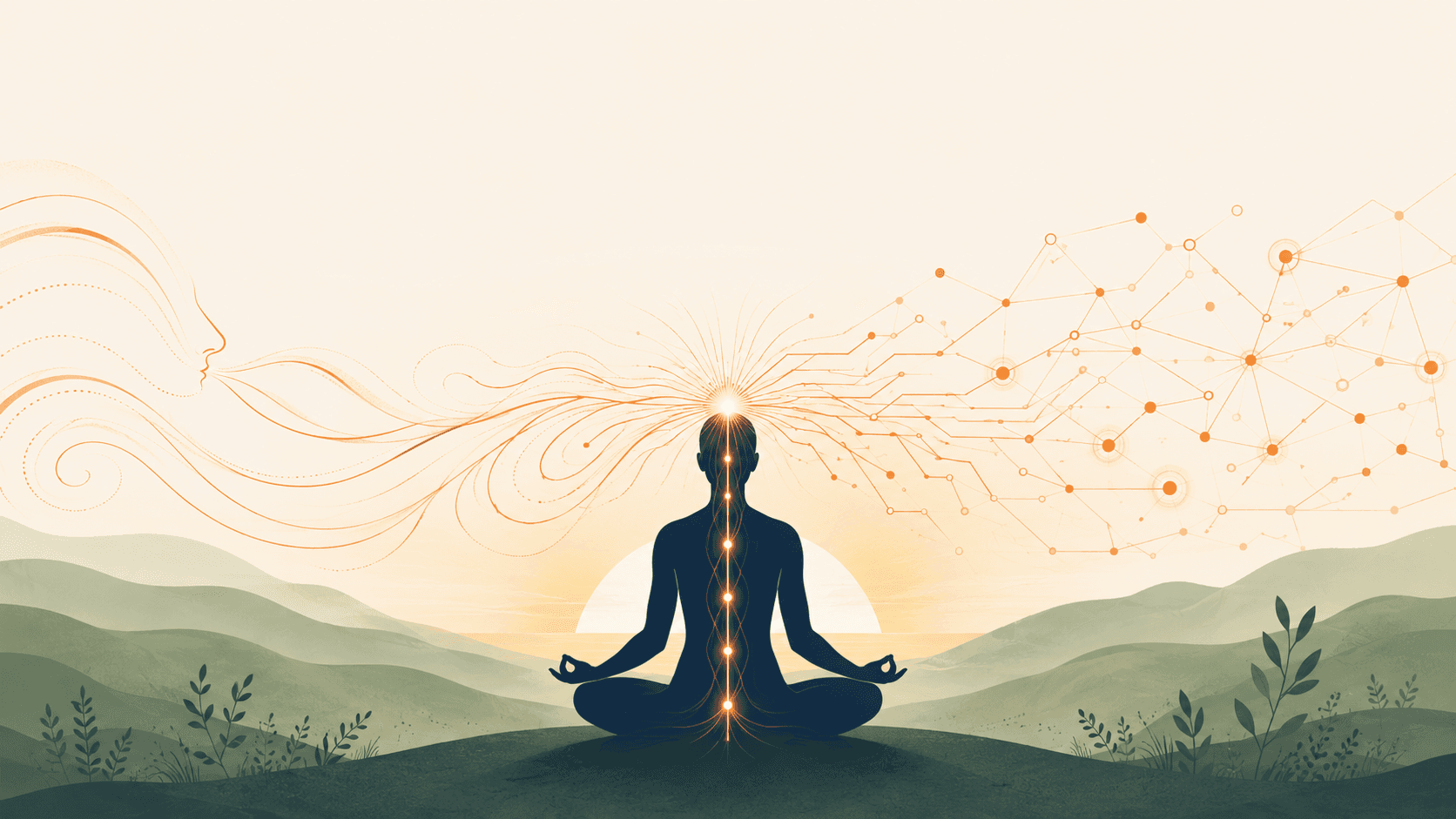
International Yoga Day 2026: What an AI-Saturated World Actually Demands From Yoga
On the 12th International Day of Yoga, the real question isn't whether yoga should embrace AI and digital health — it's whether yoga can prove its claims fast enough to deserve the trust millions are about to place in AI-powered wellness tools instead.
Quick answer: International Yoga Day 2026 (June 21, the 12th edition) carries the official theme "Yoga for Healthy Ageing." The same year, the WHO, ITU, and WIPO have jointly mapped how AI is already reshaping traditional medicine worldwide, India's Ministry of AYUSH has built AI-linked platforms like NAMASTE and Ayurgenomics, and researchers are documenting both real benefits and real risks of AI companionship for loneliness and mental health. 2026 demands that yoga respond not with more marketing, but with the same rigor, data transparency, and ethical safeguards the WHO is now asking of every traditional medicine system on Earth.
Written by Satyam Tiwari — BSc Yoga (Gold Medalist), MSc Yoga MDNIY New Delhi; Senior Research Fellow, IKSMHA Centre, IIT Mandi; Founder–CEO, YogaXBiofeedback (Dhyanly™).
Today's theme, and why it's the right one
Today, June 21, 2026, is the 12th International Day of Yoga, observed under the official theme "Yoga for Healthy Ageing" — announced by India's Ministry of AYUSH and adopted globally, including at today's observance at UN Headquarters in New York, where Secretary-General António Guterres linked yoga's emphasis on mindfulness to care for oneself, the planet, and one another. Last year's theme was "Yoga for One Earth, One Health," announced by Prime Minister Narendra Modi; this year's shift to ageing reflects a world where the population over 60 is growing faster than any other age group.
It's worth remembering how Yoga Day came to exist at all. Prime Minister Modi proposed it in his first address to the UN General Assembly on September 27, 2014, calling yoga "an invaluable gift of India's ancient tradition." The resulting resolution, adopted on December 11, 2014, was co-sponsored by a record 177 UN member states — the highest number of co-sponsors any General Assembly resolution of its kind had ever received. That is a genuinely extraordinary diplomatic achievement, and it deserves to be stated plainly rather than buried under hype: yoga already has more global institutional goodwill than almost any other health practice on the planet.
The question this blog wants to ask, honestly and a little uncomfortably, is what 2026 demands yoga do with that goodwill — because the world it's operating in this year is not the world of 2015.
The world yoga is entering in 2026
Consider what else is true on this particular June 21. AI companion apps and chatbots are no longer a novelty; they are now a documented, researched part of how millions of people manage loneliness and emotional distress. The evidence on this is genuinely mixed, and a fair accounting has to hold both sides at once.
On one hand, a Harvard Business School study published in the Journal of Consumer Research found that interacting with an AI companion reduced users' loneliness to a degree comparable to interacting with another human being, and more than passive activities like watching videos. A cross-sectional survey of adults with a diagnosed mental health condition found that nearly half who had used large language models in the past year had specifically used them for mental health support.
On the other hand, a four-week randomized controlled trial found that while some chatbot features modestly reduced loneliness, heavy daily use was associated with greater loneliness, increased dependence, and reduced real-world socializing. Psychiatric researchers have documented cases — described in the literature as a kind of "technological folie à deux" — where intense engagement with AI chatbots contributed to delusional thinking. The American Psychological Association's own January 2026 trend report on digital relationships concluded plainly that excessive use of these tools may worsen loneliness and erode social skills, and called for stronger guardrails.
This is the emotional and technological climate Yoga Day 2026 exists inside. People are not choosing between "AI" and "no AI" — that ship has sailed. They are choosing, daily, between technologies that demonstrably risk deepening isolation and practices, like yoga, that have spent millennia building exactly the embodied, in-person, breath-and-presence skills AI companionship cannot replicate. That is yoga's actual competitive advantage in 2026. It is not a small one. But an advantage only matters if you can prove it.
What the WHO is already telling traditional medicine about AI
Yoga doesn't get to have this conversation in isolation, and increasingly, it isn't having it in isolation. In July 2025, the WHO, the International Telecommunication Union, and the World Intellectual Property Organization jointly released a technical brief — Mapping the Application of Artificial Intelligence in Traditional Medicine — launched at the AI for Good Global Summit in Geneva under WHO's Global Initiative on AI for Health. The brief explicitly credits India's own proposal for pushing this work forward, and highlights real Indian examples already in motion: the Ayurgenomics project, which combines genomic data with Ayurvedic constitutional concepts to identify predictive disease markers, alongside platforms like the NAMASTE morbidity-coding portal, the SAHI portal, and the Ayush Research Portal.
The brief's recommendations are not vague platitudes. It calls on every traditional medicine system, yoga included, to invest in AI ecosystems that respect cultural diversity and data sovereignty, build national policy frameworks specific to AI in traditional medicine, expand digital literacy among practitioners, establish shared global standards for data quality and interoperability, and protect traditional knowledge through properly governed digital repositories rather than extractive ones.
This sits inside a larger institutional shift. The 78th World Health Assembly adopted the WHO Global Traditional Medicine Strategy 2025–2034 in May 2025, with its first strategic objective being, in plain terms, to strengthen the evidence base of traditional and complementary medicine through robust research and data — not folklore, not testimonials, data. India has been at the center of this institutional movement since June 2022, when the WHO and the Government of India jointly established the WHO Global Centre for Traditional Medicine in Jamnagar, Gujarat — the first WHO centre of its kind anywhere in the world, explicitly tasked with evidence, data analytics, and innovation.
In other words: the global health establishment has already decided that traditional medicine's future runs through evidence, data, and responsibly governed AI. The only open question is whether yoga, specifically, is going to lead that shift or be dragged through it.
The critical reckoning: cultural prestige isn't evidence
Here is the uncomfortable part. India's own National Sample Survey Office data from 2022–2023 found that awareness of AYUSH systems sits at a remarkable 94–96% nationally, with actual usage exceeding 50% of the population. That is an enormous foundation of trust. But trust and evidence are not the same currency, and the WHO's own Global Survey on Traditional, Complementary and Integrative Medicine has repeatedly found that the most common challenge countries report in implementing traditional medicine strategy is, specifically, insufficient research data — not insufficient interest, not insufficient cultural standing, insufficient data.
This matters more in 2026 than it would have in 2015, because the bar for credibility has moved. A generation that has grown up debugging chatbot hallucinations and reading AI model cards is not going to accept "it has worked for thousands of years" as a substitute for a peer-reviewed effect size, a confidence interval, or a pre-registered trial. That generation isn't being unreasonable. It is applying the same standard to yoga that it already applies, often more harshly than yoga ever gets, to the AI tools it uses every day.
This is also exactly why YogaXBiofeedback exists, and exactly why this caution belongs in this post rather than being smoothed over: claiming a biosensor or an app makes a practice "AI-powered" or "data-backed" is not the same as actually subjecting that practice to rigorous, peer-reviewed validation. Wrapping ancient claims in sensor hardware without doing the underlying science is not progress — it's just a more expensive and more convincing-looking version of the same unverified claim. The WHO brief's warning about protecting traditional knowledge cuts both ways: it protects communities from extraction by outside technology companies, and it should also protect the public from traditional medicine systems borrowing AI's credibility without earning it.
The visionary case: what yoga should actually build this decade
So what does 2026 actually demand? Not a yoga app that mimics a wellness chatbot, and not a rejection of technology in the name of authenticity. The honest, harder answer is this: yoga's job in the AI decade is to become the proof of concept for human-AI augmented contemplative practice — technology used to validate, personalize, and scale embodied, teacher-guided, in-person practice, rather than technology used to replace the human relationship at yoga's center.
Concretely, that means using EEG, heart rate variability, and respiratory biosensing not as marketing decoration but as instruments to test specific, falsifiable claims drawn from classical texts — the kind of work already underway in labs studying the nasal cycle's link to autonomic and brain lateralization, or resonance-frequency breathing's effect on vagal tone. It means following the WHO-ITU-WIPO brief's call for data sovereignty seriously: practitioner and community data generated through these tools should benefit the traditions and the people who practice them, not just the companies building the sensors. It means publishing negative results as readily as positive ones, because a 2025 WHO-led research-priorities exercise that explicitly compared expert consensus against large language models found real gaps in how thoroughly traditional and integrative medicine research currently gets prioritized and funded — gaps that better data, not better branding, are what will close.
And it means holding onto the one thing AI demonstrably cannot fully replace: a present, attentive human teacher, in a room, with other present human bodies. The loneliness research above isn't a footnote — it's the strongest argument yoga has. In a year when researchers are formally documenting "technological folie à deux" as a clinical phenomenon, an evidence-validated practice built on real human presence isn't a nostalgic alternative to AI. It's a tested, scalable antidote to exactly the problem AI companionship is creating for some of the people who rely on it most.
Why "Healthy Ageing" is the right test case
This year's theme is, in fact, an unusually good proving ground for all of this. According to data the Ministry of AYUSH itself cites from PubMed Central, the number of published research studies on yoga and healthy ageing grew from 183 in 2014 to 1,207 in 2025 — crossing the 500-study mark in 2020 and continuing to climb. That is exactly the trajectory the WHO is asking every traditional medicine system to demonstrate: not flat cultural popularity, but compounding scientific output.
Meanwhile, the wearable and digital health technology market — the infrastructure layer that increasingly mediates how people actually track and act on ageing-related health metrics — is itself projected by multiple market research firms to be worth somewhere in the range of $90–240 billion globally in 2026, depending on methodology and scope, with consistent double-digit annual growth forecast through the early 2030s. Healthy ageing is rapidly becoming a software and sensor category, whether yoga participates in defining it rigorously or watches it get defined without it.
A motivating close
International Day of Yoga has already won the argument about cultural reach: 177 co-sponsoring nations, a UN-recognized observance in its 12th year, a dedicated WHO Global Centre for Traditional Medicine on Indian soil, and a global health establishment that has just spent the last eighteen months building formal frameworks for exactly this moment. None of that was guaranteed in 2014, and all of it is a genuine, hard-won achievement worth marking today.
What 2026 demands now is the harder, less photogenic part: peer-reviewed trials instead of testimonials, published data instead of marketing claims, sensor validation instead of sensor decoration, and a serious, good-faith engagement with the WHO's own roadmap for AI in traditional medicine — including its warnings about data sovereignty and cultural protection, not just its opportunities. Yoga doesn't need AI to legitimize it. It needs to use AI, carefully and transparently, to finally prove — at scale, with data the rest of the world can check — what practitioners have quietly known for centuries.
Key takeaways
- International Yoga Day 2026 is the 12th edition, observed under the official theme "Yoga for Healthy Ageing," following 2025's "Yoga for One Earth, One Health."
- The 2014 UN resolution establishing Yoga Day was co-sponsored by a record 177 member states — still the highest co-sponsorship of any UN General Assembly resolution of its kind.
- AI companionship research in 2025–2026 shows genuine, documented benefits for loneliness alongside genuine, documented risks of dependence and reduced real-world socializing — both are true at once.
- The WHO, ITU, and WIPO jointly released a technical brief in July 2025 mapping how AI should be responsibly integrated into traditional medicine, explicitly citing Indian initiatives like Ayurgenomics and NAMASTE.
- India already hosts the WHO Global Centre for Traditional Medicine (Jamnagar, established 2022) and has near-universal public awareness of AYUSH systems — but the WHO's own surveys consistently identify insufficient research data, not insufficient interest, as the field's central gap.
- The honest path forward is using biosensing and AI to rigorously validate specific yogic claims and protect practitioner data, not to repackage unverified claims with sensor hardware.
Frequently asked questions
What is the theme of International Yoga Day 2026? "Yoga for Healthy Ageing," announced by India's Ministry of AYUSH and observed globally on June 21, 2026, the 12th International Day of Yoga.
How many countries supported the original UN resolution creating International Yoga Day? A record 177 UN member states co-sponsored the resolution adopted on December 11, 2014 — the highest number of co-sponsors any UN General Assembly resolution of its kind has received.
Is AI actually being used in traditional medicine and yoga right now? Yes. The WHO, ITU, and WIPO jointly published a technical brief in July 2025 documenting real, current AI applications in traditional medicine globally, including Indian initiatives like the Ayurgenomics project and digital platforms such as NAMASTE and the Ayush Research Portal.
Does AI companionship actually help with loneliness, or make it worse? The current research shows both effects depending on usage patterns: studies have found AI companions can reduce loneliness comparably to human interaction in measured contexts, while separate research has found heavy daily use is associated with increased loneliness, dependence, and reduced real-world social engagement.
References
Press Information Bureau, Government of India. (2026). International Day of Yoga 2026 Theme 'Yoga for Healthy Ageing'. United Nations. International Day of Yoga. un.org/en/observances/yoga-day. Permanent Mission of India to the UN, New York. Background Information: International Day of Yoga. World Health Organization, International Telecommunication Union, World Intellectual Property Organization. (2025). Mapping the application of artificial intelligence in traditional medicine: technical brief. World Health Organization. (2025). WHO global traditional medicine strategy 2025–2034. Adopted at the 78th World Health Assembly. World Health Organization South-East Asia Region. (2026). International Day of Yoga 2026. Frontiers in Medicine. (2025). India's journey in mainstreaming Ayush in primary health care—from tradition to integration. De Freitas J, et al. (2025). AI companionship and loneliness. Journal of Consumer Research. Fang et al. (2025). Randomized controlled study on AI chatbot use and psychosocial effects. American Psychological Association. (2026). Trends report: AI chatbots and digital companions are reshaping emotional connection. APA Monitor. Ahn S, Zhou J, Jiang D, Kerr S, Zhu Y, Song P, Rudan I. (2025). WHO global research priorities for traditional, complementary, and integrative medicine: an international consensus and comparisons with LLMs. Journal of Global Health.
YogaXBiofeedback (Dhyanly™) builds biosensing tools designed to validate, not just decorate, classical breath and yoga science — in the spirit of the evidence-first approach the WHO is now asking of traditional medicine worldwide.